
European Commission takes ambitious measures to end the destruction of unsold goods
On Monday, 9 February 2026, the European Commission took a major step forward in the transition toward a more circular economy by adopting measures to end the destruction of unsold clothing, footwear, and accessories within the European Union.
This initiative is part of the Ecodesign for Sustainable Products Regulation (ESPR), a legal framework designed to fundamentally transform how products are designed, sold, used, and recycled in the EU. France, long a pioneer in this area, had already banned the destruction of unsold non-food items in 2020 under the “AGEC” law, requiring companies to rethink their stock management and product valorization practices.
Why is this measure essential?
Each year, a significant quantity of new textile products estimated between 4% and 9% of unsold items are destroyed without ever being worn (Source: European Commission). This waste contributes approximately 5.6 million tons of CO₂ emissions.
This highlights the paradox of a still overly linear consumption model dominated by overproduction and fast fashion practices. The EU now aims to reverse this trend.
The ESPR pursues several key objectives:
- Reduce textile waste
- Limit environmental impacts
- Accelerate the transition to a circular economy
- Ensure fair competition among companies within the European market
Managing unsold goods is therefore no longer just a logistical or financial issue: it has become a regulatory and strategic challenge.
What do we know about the new rules?
1. Ban on the destruction of unsold goods
Starting 19 July 2026, big-sized companies placing clothing and footwear on the EU market will no longer be allowed to destroy their unsold items. Medium-sized companies will be required to comply by July 2030.
Exceptions are allowed only in specific, justified cases, such as safety or hygiene issues, or damage that renders the product unfit for sale, donation, or recycling.
2. More transparency
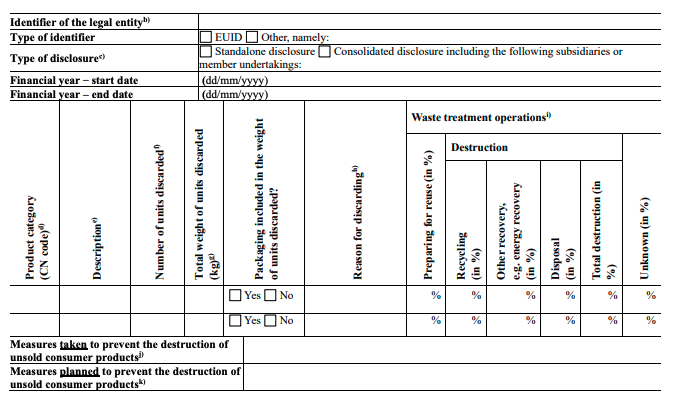
Large companies will be required to report, each year, data and information regarding the management of their unsold and discarded goods placed on the market, using a harmonized format across the EU.
Key information to be reported includes:
- HS code (Harmonized System code)
- Description of the discarded product
- Presence of packaging on the discarded product
- Quantity of destroyed unsold goods
- by number of units
- by weight (kg)
- Reasons for destruction
- Breakdown of unsold goods destinations (%)
- preparation for reuse
- recycling
- energy valorization
- disposal
- unknown
- Measures taken to prevent the destruction of unsold consumer products
- Planned measures to avoid the destruction of unsold consumer products
3. Planned sanctions
Each member state will be required to establish proportionate and dissuasive sanctions for companies that fail to comply with these new obligations.
The practical implementation of this new regulation will depend on how Member States enforce it and on companies’ ability to adapt their practices. This development also takes place within a broader context of revising European textile policies, including the introduction of Extended Producer Responsibility (EPR) schemes, separate collection of textiles, and stricter environmental transparency requirements.
Weturn welcomes these developments as a strong signal to all economic actors.
Weturn: Your strategic partner for ESPR compliance
Thanks to its expertise and its digital tool Valo, Weturn supports brands at every stage of compliance with the new ESPR regulation.

From managing unsold goods to documenting and tracking flows, Valo enables companies to:
- Manage their inventory and optimize valorization by leveraging a network of certified donation and reuse partners, while ensuring that all flows comply with the European definition of destruction.
- Centralize and automate regulatory reporting with a harmonized format, complete product traceability, and secure document storage.
- Benefit from tailored support with strategic and operational guidance to turn regulatory obligations into business opportunities.
By centralizing data, reporting, and valorization channels on a single platform, Valo is designed to help brands manage their unsold inventory (in addition to dormant stock such as defective items and production rolls), while continuously updating to remain compliant with evolving regulations.